

Key Takeaway
Harley-Davidson has used the Bar and Shield since 1910, and it's the emblem most Harley-Davidson tattoos are built around. The V-twin, the eagle wings, and the Willie G skull carry the rest. The story that Harley handed riders a discount on a bike for already having the logo tattooed is one nobody can produce a record for — individual dealers have given away free tattoos, which is a different thing entirely.
A Harley-Davidson tattoo is one of the few brand tattoos people get without a second thought. You don't see much Yamaha script on forearms, or Kawasaki emblems across shoulder blades. Ask why the Bar and Shield is different and someone will eventually tell you the company used to hand out discounts for it. That story is worth checking before you sit in the chair — and so are the four motifs that keep coming up: the logo, the engine, the wings, and the skull.
Did Harley Really Give Discounts for Tattoos?
The story goes like this. Get the HD logo tattooed, walk into a dealership, show the ink, and walk out with a guaranteed discount on your next bike. Real tattoos only — no transfers. Riders got money off, Harley got permanent walking billboards.
We went looking for the paperwork and came up empty: no archive entry, no dated campaign, no dealer bulletin. Search for it and you mostly find blogs repeating each other's wording. That isn't proof the promotion never happened anywhere — you can't prove a negative out of an incomplete archive — but nobody who repeats the story seems able to point at the source of it either. It sits alongside the other Motor Company stories that get repeated far more often than they get checked.

What is documented runs the other direction. In 2013, Milwaukee Harley-Davidson — one dealership, not the company — gave away free logo tattoos during a 110th-anniversary party that stayed open around the clock. Dealers have absolutely run tattoo promotions. Giving a tattoo away is just not the same as knocking money off a motorcycle because you already had one.
The loyalty itself was built somewhere more boring. Harley-Davidson launched the Harley Owners Group on January 1, 1983, and closed that first year with roughly 33,000 members across the US and Canada. The company describes H.O.G. as the largest factory-sponsored motorcycle club there is. Belonging was the product. The tattoos followed on their own.
⚠️ Before you book: the Bar and Shield is an active Harley-Davidson trademark. A personal tattoo and a product you sell sit in completely different legal territory — trademark infringement generally turns on use in commerce and likely confusion. Riders sometimes blur those two things together. Don't.
Worth knowing before you commit: biker ink carries its own etiquette, and in some clubs insignia and club-logo tattoos are tightly controlled markers of membership. We cover which ones in our guide to biker tattoo meanings and the unwritten rules. A brand logo isn't one of the risky ones — the patches some riders pair it with can be.

Pick Your Bar and Shield Era Before You Pick the Size
Harley-Davidson filed its US trademark application for the Bar and Shield on July 19, 1910, and a later application filed in 1930 stated the mark had been in continuous use since May 6, 1910. The design turns up on the back cover of the company's 1910 catalog.
Who actually drew it is a genuine blank. You'll find origin stories online crediting a founder's relative with painting it on the workshop doors — the Harley-Davidson Archives themselves state that no records confirm who designed the logo or what inspired it. A 116-year-old emblem nobody can sign for is a strange thing to wear permanently, and some riders like it more for exactly that reason.
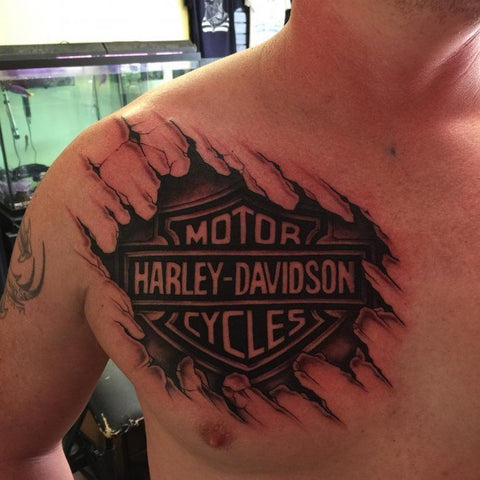
The emblem has moved through several distinct eras, and which one you pick drives everything else — line weight, colour, and how much skin it needs:
| Era | What changed | Tattoos best for |
|---|---|---|
| 1910 | The trademark-application design, appearing in varied printed treatments | Weathered, blackwork, or fine-line pieces |
| c.1922 | First documented association with black and orange — the colour pairing everyone now reads as "Harley" | Bold traditional with solid colour packing |
| 1940–1946 | The first metal tank emblem — a teardrop badge, worn on Big Twins through 1946 | Riders of knuckle- and panhead-era bikes |
| 1955 | A prominent "V" in the tank badge, referencing the engine layout | Anyone pairing the logo with an engine design |
| by 1964 | Simplified, modernized versions replace the older emblem | Small-scale work — wrist, hand, behind the ear |
| 1976 | The heritage version Harley-Davidson still uses today enters service | The default choice; reads clean at any size |
| 2003 | Centennial branding — special Bar and Shield medallions and 100th-anniversary marks | Large chest and back pieces with room for detail |
| 2008 | 105th-anniversary styling and badging across 14 models; the Rocker, Rocker C and Dyna Fat Bob were that year's new bikes | Owners marking a specific bike they had |

Each era has its people. Some take the '76 heritage mark because it's clean and unmistakable even at wrist size. Others choose the centennial branding because they were riding when it dropped — it marks their generation. A few go with the pre-war design in a faded, weathered style, because it carries more history in fewer lines. The version you choose says something about when you fell in love with the brand.
V-Twin Engine Tattoos — The Sound You Can See
The V-twin is as much a Harley-Davidson symbol as the Bar and Shield. A prototype appeared publicly in 1907, and the 45-degree 5-D entered the 1909 line — though only about two dozen were built before the model was pulled, and it didn't return for 1910. The layout stuck around rather longer.
Engine tattoos come in every style. Some riders go for mechanical precision: every cooling fin, pushrod, and rocker cover rendered in photorealistic black and grey. Others prefer stylized versions — the V-twin wrapped in flames, merged with a skull, or set against an American flag. That second family borrows directly from old-school American traditional flash, which is built on heavy black outlines and a deliberately limited palette.
One recurring variant sets the V-twin inside a heart. The shape borrows from traditional heart-and-banner flash — the kind Norman "Sailor Jerry" Collins put on thousands of service members in Honolulu during the Second World War — with the engine standing in for the sweetheart's name. Whether that lineage was ever deliberate isn't recorded anywhere we could find. The composition works regardless.
Then there's the sound. Harley keeps both connecting rods on a single shared crankpin, which produces an uneven firing interval — a quick pair of power strokes, then a long pause. That's the "potato-potato" idle. No tattooer can reproduce it, but an engine rendered in ink carries the shape that makes it.
Eagles, Wings, and the HD Emblem
Eagle imagery has run through Harley-Davidson branding for decades — an art-deco Harley eagle is documented as far back as 1933, and wings reappeared around the 100th-anniversary branding in 2003.
HD eagles have a particular look. The company's version tends toward sharp, angular wings with a mechanical edge — more chrome than nature. Riders who get these tattooed often add their own touches: flames trailing from the wingtips, the Bar and Shield centered in the eagle's chest, or the Stars and Stripes worked into the feathers. The same angular treatment shows up in metal across our eagle ring collection, which is where a lot of riders go once the ink is healed.

Wing tattoos without the full eagle are common too. A pair of spread wings across the upper back with "Harley-Davidson" scripted between them suits the shape of the area — broad, horizontal, symmetrical — and some riders go bigger still, stretching the wingspan shoulder blade to shoulder blade. The jewelry equivalent is a piece like the 32-gram Soaring Eagle Ring, where the spread wings wrap the band instead of the spine.

Willie G Skull vs the Generic Biker Skull
You can't talk about Harley-Davidson's visual identity without Willie G. Davidson. Grandson of co-founder William A. Davidson, he joined the company in 1963 and stayed until announcing his retirement in 2012 — nearly five decades shaping how the bikes look. The skull motif that carries his name is still an official Harley-Davidson product line, not a fan invention; the company runs a Willie G Skull collection to this day.

Set it beside a generic biker skull and the difference is obvious. No crossbones, no grim reaper, no gore — just the skull, sometimes with the Bar and Shield worked into it or a flame motif behind. Because Harley sells it as branded merchandise, the motif reads as a specifically Harley skull rather than a generic one. If you want that same restraint in silver, a stripped-back piece like the Skeleton Skull Ring in heavy .925 sterling sits closer to it than any of the ornate designs. The broader symbolism — mortality, remembrance, defiance, and yes sometimes menace — we unpack in our breakdown of what skull tattoos actually mean.
Where the Flames Came From
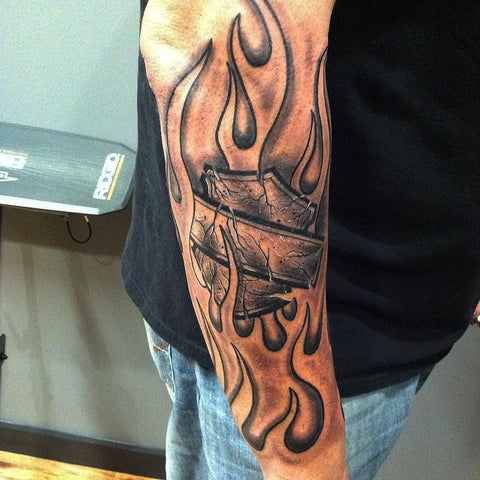
Flames are the other defining HD visual, and they came out of the custom-paint world rather than the factory. Painted flame jobs appear on hot rods before the Second World War and spread through the 1950s custom scene; Von Dutch, who did much of that early work, said he was custom-painting motorcycles around 1947 before anyone talked him into doing a car. Those same patterns move straight from tank to skin — hot-rod orange fading to yellow, pinstriped edges, black grounds — and a flame tattoo can borrow the exact colours and contours of a custom paint job.

Pairing HD Tattoos With Biker Jewelry
Skull, eagle and flame motifs run through biker jewelry as much as biker ink — skull rings, chain wallets, eagle pendants. Which means it's easy to end up with two versions of the same image fighting each other.
Match line weight before you match motif. That's the practical version, and it's the question we get asked most often about wearing rings alongside ink. A bold black-outline tattoo sits better next to a stripped-back silver silhouette than next to a ring covered in fine relief detail — put heavy ink and a busy ring on the same hand and neither one reads. Spread-wing designs behave the same way: pick metalwork whose wings stay legible at arm's length instead of competing with the tattoo underneath.

In some American motorcycle clubs, insignia and club-logo tattoos are closely controlled markers of membership — which is exactly why a brand logo is the safe thing to wear and a patch is not. A Skeleton Skull Biker Wallet and a forearm V-twin commit you to nothing but taste.
Frequently Asked Questions
Does a Harley-Davidson tattoo mean something different from a club tattoo?
Yes, and the difference matters. A brand logo is something anyone can choose. Club insignia and club-logo tattoos are controlled markers of membership in some motorcycle clubs, earned rather than picked. Wearing the Bar and Shield says what you ride or admire; wearing a patch you have no claim to is a different conversation entirely.
Can I get in trouble for tattooing a trademarked logo?
A personal tattoo and a product you sell are not the same thing. Trademark infringement generally turns on use in commerce and likely confusion, so wearing the Bar and Shield on your own arm sits in different territory from printing it on merchandise. Selling flash, prints or goods carrying the logo is where the risk starts.
How do I choose a placement for a Harley-Davidson tattoo?
Let the design's detail set the size, then pick an area that fits it. A compact Bar and Shield holds up on a forearm or wrist. A full V-twin or winged emblem carries fine lines that crowd at small scale, so it wants a broader panel — back, chest or thigh. Size it from the stencil.
Do you have to own a Harley to get a Harley-Davidson tattoo?
Ownership is not a prerequisite — there's no company rule and no legal one. People get HD ink for what the brand represents: freedom, rebellion, American manufacturing. Reactions among riders vary and shouldn't be treated as a universal rule, though wearing a brand you've never ridden can invite a question or two at a stop.
Pick the era before you pick the placement — a 1910-era Bar and Shield and the 2003 centennial branding want completely different amounts of skin. And if someone at the shop tells you Harley used to pay for this in bike discounts, you now know more about that story than they do.