

A biker chick outfit comes down to four pieces: a leather jacket with an asymmetric zip, dark slim trousers, heavy black boots, and silver hardware. Get those right and everything else is decoration. The look began as borrowed men's motorcycle gear and became one of the few styles that reads as tough and feminine at once — which is why it outlasts the trend cycle instead of dating with it.
This guide covers what to buy, what each piece does, and how to build the look — whether you ride, style it for the street, or need a costume by Friday.
Key Takeaway
If you only get one thing right, get the zip line right — diagonal reads biker, straight reads bomber. Everything after that is palette, boot weight and metal color. Budget accordingly: the jacket is the only piece where fit is worth more than hardware.
What Makes an Outfit Read as Biker Chick
Four signals do the work, and you need at least three of them for the look to land:
- The diagonal zip. A straight center zip reads as a bomber or a coat. The slant is the tell.
- A dark, narrow bottom half. Black leather, black denim, or worn indigo — cut close so the jacket's volume has something to sit against.
- Boots with visible hardware. Buckles, straps, or lacing. A plain ankle boot goes quiet next to a moto jacket.
- Silver, not gold. Chrome, nickel, and sterling all sit in the same cool register as the bike itself. A wide belt with a heavy buckle counts here too — it's metal at the waist.
Miss all four and you have a black outfit. Hit three and you have the look, even in a dress. Each piece below gets its own section — including which biker girl outfits work on an actual bike rather than only in photographs.
Start With the Jacket
Everything else in the outfit adjusts around this one piece. Three things decide whether it works: where the shape came from, what it's made of, and how it fits your shoulders.
Where the Perfecto Came From
Irving Schott introduced the Perfecto in 1928 — heavy leather, asymmetric front, sold through a Long Island Harley-Davidson dealer — and named it after his favorite cigar. Schott calls it the first modern motorcycle jacket, and modern is the load-bearing word there: leather gear cut for riders was already being made in the early 1920s. What 1928 fixed was the shape everything since has copied. The angled zip wasn't styling. Set on a diagonal, one front panel laps well over the other instead of meeting it edge to edge, so a closed jacket puts leather across the chest rather than a cold seam down the middle. Which side laps over which flips between men's and women's cuts, so don't read anything into it. The belted waist, zip cuffs and fold-up collar were all doing the same job.

Marlon Brando wore a Perfecto-style black leather jacket in The Wild One in 1953, and the jacket stopped being equipment. Which jacket exactly is still argued over. Schott's own history credits its Perfecto One Star; other researchers read it as a 618 with the stars added for the film. The screen-worn coat never surfaced to settle it. Some American high schools banned leather jackets on campus in the years that followed, which did more for the garment's reputation than any advertising could have. The same coat later got picked up by punk, and fifty years of subcultures wore it into a uniform without changing the pattern much at all.
Which Material Fits Your Budget
The material decides the price, the weight, and whether the jacket is protective gear or a styling piece. Both are legitimate — just know which one you're buying.
| Material | Weight & feel | Best for |
|---|---|---|
| Thick cowhide | Heavy, stiff for the first month, then molds | Actually riding — abrasion resistance |
| Goatskin or deerskin | Thinner, supple from day one | Daily wear without the break-in period |
| Suede | Light, soft, matte | Softening the look — keep it out of rain |
| Denim | Structured, breathable | Summer, and layering under a vest |
| Eco-leather / textile | Lightest, holds a sharp shape | The silhouette without animal products |

Getting the Fit Right
A moto jacket is cut closer than almost anything else in a wardrobe, so the fit checks are different too:
- Shoulder seam sits on the shoulder bone. If it hangs past, the whole jacket reads borrowed — the one measurement a tailor can't easily fix.
- Zip it up before you decide. These jackets are designed to be worn closed at speed; a lot of them fit completely differently open and shut.
- Reach forward as if for handlebars. Sleeves ride up several centimeters in that position. Riding cuts run longer in the arm for exactly this reason.
- Leave room for one layer. A jumper underneath is the difference between a three-season jacket and a two-month one.
- Pick your hem length deliberately. Cropped stops at the waist and lengthens the leg line; longline covers the hip and works better over dresses.
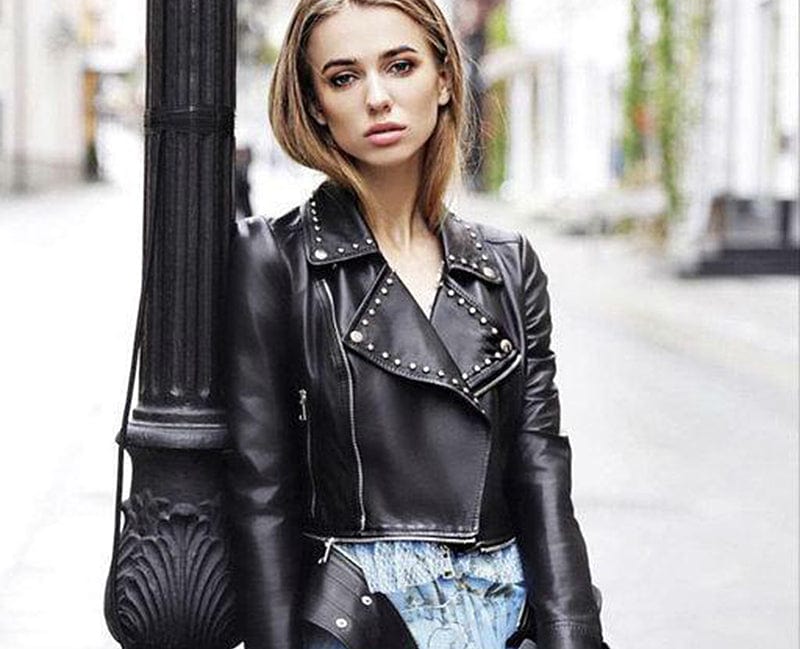
Jacket Variations Worth Knowing
The Perfecto shape survives a lot of alteration without losing what makes it readable, which is why the look keeps coming back instead of cycling out. Three variations change the register most: the collar, the surface, and how much metal is on it.
Shearling and Fur Collars
A shearling collar is the standard way to push a moto jacket into winter without losing the shape. Real or faux, the collar does two things: it fills the gap the fold-down collar leaves at the throat, and it breaks up an otherwise flat black upper body. Removable linings are worth looking for — they turn one jacket into a three-season jacket.

A cream or white collar is the louder choice. It puts a hard light-dark line right under the face, which is flattering but far less forgiving of dirt — pale shearling picks up collar grime from make-up and hair product within a season of daily wear.

Suede in Color
Suede is the easiest way to wear the shape without the severity. It comes from the underside of the hide, so it's softer and more matte than smooth leather — and considerably more vulnerable. Water stiffens and discolors the nap, which is why suede belongs to dry days and short walks. Burgundy, muted green, gray and beige all work better in suede than they do in smooth leather, where off-black colors tend to look like a mistake.

Studs, Spikes, and Embroidery
Studding started with rockers and punks rather than with motorcycle clubs, and it's still the fastest way to make a plain jacket loud. The practical cost is weight and snagging — a densely studded jacket is heavy on the shoulders and will catch on knitwear, seatbelts and bag straps.

Embroidery is the quieter alternative and usually lives on the back panel, where there's room for a single large motif. Skulls, snakes, dragons, tigers and floral work all show up regularly — the same motif vocabulary that runs through biker ring designs. Worth knowing before you buy something with lettering or a badge on it: club patches are a separate language with rules attached, and it's worth understanding what biker patches and symbols actually signal before wearing one.

Trousers, Skirts, and What Actually Works on a Bike
The bottom half is where the styled version and the riding version separate. For the street, narrow and dark is the whole rule: black leather trousers, black skinny jeans, or worn indigo denim. Burgundy and deep brown leather both work if you want out of black, as long as the jacket and trousers aren't fighting each other for attention.
Skirts, shorts and dresses are all fair game off the bike, and pair better with the jacket than most people expect — the contrast is the point. On the bike they're a different conversation. Bare legs and a hot exhaust are a bad combination, and denim offers very little in a slide.
⚠️ Worth being clear about: a biker chick outfit is styling advice, not protective gear. Fashion leather is thin and unarmored. If you're actually riding, that's a separate purchase with armor at the hips, knees and shoulders — we cover which gear actually protects you in its own guide.

Boots: What Lasts and What Doesn't
Black, thick-soled, and visibly buckled. That's the brief. Engineer boots, combat boots and harness boots all read correctly; a plain Chelsea boot doesn't, however good the leather is. Contrast lacing and chunky metal hardware are what carry the look at ankle height, where nobody is looking closely enough to notice anything subtle.
Finish matters more than most buyers expect. Full-grain leather keeps the whole grain layer — the fine, densely woven outer tissue — so it scuffs and burnishes instead of flaking off. What it won't do is shrug off water on its own. That comes from the waterproofing worked in at the tannery and from whatever wax or cream you feed it afterwards. Patent and lacquered finishes are a synthetic resin film laid over leather — polyurethane in most patent made today. That film has different elasticity from the hide underneath, so every flex at the toe box works the two against each other until the surface crazes. Once it cracks, it doesn't repair. Suede sits at the other end: comfortable and light, but water stiffens, shrinks and discolors the nap, so it's the shortest-lived of the three. Construction decides more than the hide does, though. A welted boot can be resoled again and again; a cemented one usually can't be resoled at all.
💡 Pro tip: if you want the gloss without the cracking, look for a high-shine wax polish on full-grain leather rather than a patent coating. You have to buff it back up every few weeks, but the finish is repairable and the boot outlives the look.
Silver Is the Metal That Carries It
Silver outruns every other metal across the biker jewelry we stock — more than eight in ten pieces on the site are sterling. Part of the reason is visual. Chrome, nickel and polished steel are what a motorcycle is made of, and sterling sits in the same cool gray register. Gold fights it. Dark oxidized silver is the exception worth making — recessed shadow in the detail reads as age rather than shine.
The belt is the piece most people skip and shouldn't. A wide band with a substantial buckle gives the eye somewhere to land between jacket and boots, and it's the one accessory that works equally over jeans and over a dress. A crocodile belt with a sterling silver buckle does that job in color rather than plain black, which stops an all-black outfit from flattening out in daylight.
For hands and wrists, the practical constraint is that heavy rings and cuffs get in the way of grips and gloves. A stone-set women's skull ring keeps the motif without the bulk of a heavy men's band. On the wrist, a stingray leather and sterling bracelet is the opposite decision — 78 grams, 12mm across the link. It clears a jacket cuff, but you feel it on the throttle. We compare that ring's 22 mm face with nine other skull designs in our women's skull ring comparison.
At the neck, one pendant on a long chain beats three short ones, because a moto jacket's collar eats anything sitting high. A crown skull pendant hung low enough to clear the zip reads clearly against a plain tee. Fingerless gloves, a dark studded bag, and a bandana finish the set.
Softening the Biker Chic Look for Everyday Wear
The softened version is the one fashion writers call biker chic, and it exists because the full black-on-black version is a lot for a Tuesday. The reliable fix is to keep exactly one hard element and make everything else soft: jacket over a chiffon or silk dress, jacket over a lace midi, jacket with a pleated skirt and flat boots. The jacket stops the soft pieces from reading as sweet, and the soft pieces stop the jacket from reading as costume.

Color is the other lever. A jacket in dark green, navy, oxblood or gray keeps the silhouette and drops most of the aggression, which is roughly the path biker clothing took into mainstream fashion in the first place.
Building a Biker Chick Costume in a Hurry
A biker girl costume has a different job from an everyday outfit: it has to be legible across a room in bad lighting, to people who will glance at you once. That means exaggerating the four signals rather than balancing them.
- Jacket first, and it can be fake. A cheap eco-leather moto jacket photographs almost identically to hide under artificial light. The diagonal zip is the only detail that has to be right.
- Black bottoms, no exceptions. Skinny jeans, leather-look leggings or a black skirt. Rips help.
- Boots you can stand in for five hours. Combat boots beat heeled boots every time, and buckles photograph better than laces.
- Overload the silver. Stacked rings, a wide cuff, a long pendant, a studded belt. This is the one context where more is correct.
- One prop. A bandana, fingerless gloves, or aviators. Pick one — all three at once tips into fancy dress.
Hair and Make-Up for a Biker Chick Costume
Hair first, because it decides whether the rest photographs. Loose hair disappears the moment a helmet or a bandana goes on, and it flattens under indoor light. A low messy braid or a half-up knot holds its shape all night and still reads undone. If you are wearing the bandana, tie it before you style anything else and work around it.
Make-up follows the same rule as the jewelry: legible across a room. Heavy liner top and bottom, matte skin rather than dewy, and a dark lip — berry, brick or black-red. Skip the contour; it photographs as shadow under bar lighting and does nothing at three meters. Nails short and dark, because long ones fight the rings, and rings are the part people actually look at.
Skip the fake tattoo sleeves and the plastic novelty helmet. They're what push the look from "biker" into "costume shop", and the jewelry is doing that work better anyway. For a version of this that isn't gendered around the biker chick idea, we keep a general biker outfit guide covering the same pieces for any rider.
The Women Who Made This Look Real
There's a persistent story that female bikers are a recent thing — that women were shut out of motorcycling until lately and only ever rode as passengers. The record says otherwise, and the real history is a better reason to wear the jacket than the myth is.
Sisters Augusta and Adeline Van Buren rode two Indian Power Plus machines from Brooklyn to California in 1916 — more than 5,000 miles, partly to argue that women could serve as military dispatch riders. Along the way they became the first women to ride motorcycles to the summit of Pikes Peak. They were arrested more than once for wearing trousers. Bessie Stringfield started riding long distance on her own at nineteen, around 1930, picking destinations by tossing a penny onto a map — eight solo rides across the United States through the 1930s and '40s, by her own account. During the Second World War she rode as a civilian dispatch courier for the US Army, carrying documents between domestic bases.
Organized clubs followed. Dot Robinson and Linda Dugeau founded the Motor Maids in 1940 with 51 charter members, after spending three years tracking down enough women riders to form it. The American Motorcycle Association — as the AMA was called until 1976 — issued the club charter number 509 in 1941. It's still running, which makes it the longest continuously operating women's motorcycling organization in North America. By the Motorcycle Industry Council's 2018 owner survey, its most recent, 19% of US motorcycle owners were women. That's up from 14% in 2014 and 12.3% in 2008, and roughly double the 9.6% the MIC recorded in 2003.
Why this matters to the outfit
The pieces weren't handed down as a costume. Trousers, boots and the Perfecto were adopted by women who needed them to ride, in the face of people who'd rather they didn't — which is exactly why the look still carries weight a century later.
Frequently Asked Questions
What is the signature piece of a biker chick outfit?
A leather jacket with a diagonal zip — the Perfecto silhouette Irving Schott introduced in 1928. The slant is functional: the front laps across the chest instead of closing down the center, so wind hits leather rather than the zip line. Modern versions come in cowhide, goatskin, suede, denim and faux leather, so there's an option at every price.
Can you build the look without real leather?
Yes, and under artificial light it photographs nearly the same. Faux-leather and textile jackets hold the asymmetric silhouette without animal products, though they won't soften and mark the way hide does; denim works for summer. Pair either with black boots and silver jewelry. The one detail worth insisting on is the diagonal zip.
Which boots last longest with a biker outfit?
Full-grain leather, by a wide margin. The grain is the densest part of the hide, so it scuffs and burnishes rather than flaking. Construction matters just as much: a welted boot can be resoled again and again, a cemented one usually can't. Patent finishes crack where the toe flexes, and suede is the least durable.
Why is biker jewelry almost always silver?
Because it matches the machine. Chrome, nickel and polished steel are what motorcycle hardware is made from. Sterling silver sits in that same cool gray register, while gold competes with it. More than eight in ten pieces we stock are sterling. Oxidized silver is the common variation — darkened recesses read as age against black leather.
If you're buying one piece to start with, make it the jacket, and spend the money on fit rather than on hardware. Studs can be added later. A shoulder seam in the wrong place can't be fixed at all.