

A biker outfit is built from four things: a leather jacket cut to be worn at speed, bottoms that hold up to a slide, boots that cover the ankle, and hardware — buckles, chains, rings — that survives being knocked against a bike. The hardware is where preference lives. The rest is doing a job. This biker outfit guide goes through each piece: where it came from, what it’s actually for, and what to look for when you buy one, whether you ride or just like the way it looks.
Key Takeaway
Most of the biker outfit started as equipment — the Perfecto, engineer boots, chaps — and became clothing afterwards. The one line worth respecting is club insignia: jackets, vests, boots and buckles are yours to wear, but a club’s colors are issued by that club, and they aren’t sold or copied.
The Jacket Is the Whole Argument
Irving Schott introduced the Perfecto in 1928, built for motorcycling from the first day at the request of a Harley-Davidson distributor. The Museum at FIT traces its cut back to the black leather jackets of German First World War aviators, with every element reworked for riding — snaps and zippers in place of buttons, a waist cropped for movement in the saddle. Schott sold it through a Long Island Harley-Davidson dealer and named it after his favorite cut of cigar. The diagonal front was functional from the start: set on an angle, the panels lap across the chest so a closed jacket puts leather over the sternum instead of a cold seam down the middle. The belted waist, the zip cuffs and the fold-down collar all work on the same problem — the gaps wind gets into at speed.

From the Harley Dealer to the Screen
Marlon Brando wore a Perfecto-style black leather jacket in The Wild One in 1953, and the jacket stopped being only equipment. Which jacket exactly is still argued over — Schott’s own history credits its Perfecto One Star, other researchers read it as a 618 with the stars added for the film, and some collectors argue it was never a Schott at all. No catalogued screen-worn jacket has surfaced to settle it. What isn’t in doubt is the effect. The Museum at FIT records that some American high schools prohibited the biker jacket in reaction to the film, and that The Wild One stayed banned in Britain until 1967.
Punk took it next. The Ramones put the same silhouette on album cover after album cover through the late seventies, which is why the leather jacket reads as punk uniform rather than motorcycle equipment to anyone who came to it through music. In London the thread ran separately through Vivienne Westwood and Malcolm McLaren’s shop on the King’s Road. Fifty years of subcultures later the pattern has changed remarkably little — we trace it era by era in our punk leather jacket history.

What to Look For If You Actually Ride
- Weight of the hide. Fashion leather and abrasion-resistant leather are different products. A jacket sold as clothing isn’t riding kit — and plenty of Perfecto-style jackets in fashion stores are exactly that, whatever Schott’s original was built for.
- Armor pockets. Shoulders and elbows, and a back pocket if you want it. Armor works where it actually sits on the joint, which is why fit matters more here than on a fashion jacket.
- Sleeve length in the riding position. Reach forward as if for bars. Sleeves ride up several centimeters; riding cuts are drafted longer in the arm for exactly that reason.
- Room for one layer. Leave room for a sweater. That’s often the difference between a jacket you wear two months a year and one you wear most of them.
Vest or Cut — and Why It Goes Over Everything
The biker vest began as a cut-off: sleeves taken off a denim or leather jacket, leaving a flat back panel with nothing to interrupt it. The flat panel is the display surface — it’s where insignia goes. In summer the cut is worn on its own; in cold weather it goes over the jacket rather than under it, which looks odd until you understand the logic — whatever is on the back stays the outer layer.
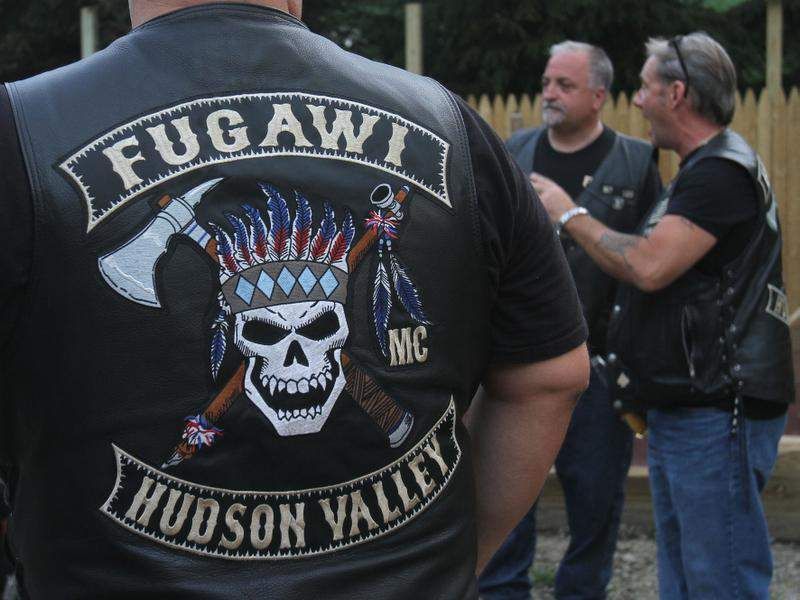
Many riders use a cut for personal patches — rallies attended, countries ridden, memorials. Those are a different object from a club’s colors. Most clubs treat colors as club property: issued to a member, returned when they leave, and never sold or reproduced. How club insignia is structured — the rockers, the emblem, the "MC" square, and who is entitled to wear what — is its own subject. We cover it properly in our guide to American motorcycle clubs.
Bottoms: Denim, Leather, or Chaps Over the Top
Dark and close-cut is the look; abrasion resistance is the function, and the two don’t automatically come together. Plain fashion denim gives you very little in a slide. Riding denim with an aramid lining is a genuinely different product, and leather pants are different again — heavier, hotter, and more forgiving of road contact than fashion denim.
Chaps sit over the top of whatever you’re already wearing. The name comes through Spanish chaparreras, from chaparro — the low thorny scrub that Mexican vaqueros rode through, and which chaps were built to keep off their legs. They were worn over pants from the beginning, which is exactly why they work for riders: pull them off at the destination and you’re standing there in clean jeans.

Boots, Gloves and the Small Stuff
Boots need to cover the ankle, grip a peg, and have a sole that won’t slide on a wet gas-station apron. Engineer boots — the tall, buckled, laceless pattern — were industrial workwear before riders took them on, which is also why they’re built the way they are. Harness and combat boots read the same way. A plain Chelsea boot doesn’t, however good the leather is.
Gloves are worth more than they look — they are the difference between putting a hand down and putting skin down. Eyewear does a job too: at speed it is wind, grit and insect strike you are keeping out, which is why riders wear glasses or a shield even on short runs. A thin liner under a helmet manages sweat, as long as it does not change how the helmet sits. And a wallet on a chain earns its keep — it stops the wallet leaving your pocket at 70mph, which is the practical reason wallet chains caught on with riders. A braided leather chain does it without the weight of steel.

Silver Is the Hardware Rule
Chrome, nickel and polished steel are what the eye picks out on a motorcycle, and silver sits in the same cool gray register. It shows in what we stock: as of August 2026, 989 of the 1,200 pieces in our active catalog are silver, and fewer than 90 mention gold at all. A heavy belt buckle is the piece that’s easiest to overlook, and it’s the one that gives the eye somewhere to land between jacket and boots. A flame-skull buckle and a pair of skull rings do the rest.

Two symbols come up constantly and are worth being straight about. The Iron Cross is an 1813 Prussian military decoration. American hot-rod and motorcycle culture picked it up in the 1950s and 60s as shock-value iconography, worn well away from its original context. It’s since been adopted by groups most wearers want nothing to do with, so it’s worth knowing how a given design reads before you wear it.
The 1% diamond is different in kind: within club culture it’s a claim to outlaw status. The story goes that it answers an American Motorcycle Association remark about 99% of riders being law-abiding — a line repeated everywhere, though the AMA says it has no record of ever making it. Worn as jewelry it’s a piece of biker iconography like any other; worn as a patch on a cut it’s a statement you have to be entitled to make.
Wearing the Biker Outfit Without a Bike
You can wear a biker outfit — jacket, boots, denim, buckle, rings — without owning a motorcycle, and no part of it needs a license. The rule that still holds: club colors are not costume. For the women’s version of the same pieces, the biker chick outfit guide goes through it step by step.
Pattern, Not Just Size
Biker gear was never men-only. Augusta and Adeline Van Buren rode two Indian Power Plus machines from Brooklyn to California in 1916 — more than 5,000 miles — partly to argue that women could serve as military dispatch riders. The Motor Maids have been running since 1940. By the Motorcycle Industry Council’s 2018 owner survey, 19% of US motorcycle owners were women.
What changes in a women’s-specific jacket is the pattern, not the idea. A proper women’s cut is drafted on its own block — shorter back length, a different shoulder-to-waist ratio, shaping through the waist — rather than a men’s shell sized down. That matters more on a riding jacket than a fashion one, because armor works where it actually sits on the joint. On a Perfecto-style jacket, the asymmetric zip is the same on both.
Frequently Asked Questions
What is the difference between a biker vest and a cut?
The terms overlap. A cut is a sleeveless vest, named for the cut-off jacket it started as — sleeves removed to leave a flat back panel for patches. Riders use cuts for personal patches as often as for club insignia. The restriction sits on the insignia, not the garment: a club’s colors stay club property, enforced by bylaws and trademark.
Do wallet chains actually stop a wallet falling out?
Yes, provided the clip attaches to a belt loop rather than the pocket edge. A chain tethers the wallet through the seated, wind-hit hours where a back pocket loosens its grip. Length matters as much as strength: enough slack to reach a toll booth, not enough to catch on a peg.
Should biker jewelry match the chrome on the bike?
Matching exactly is not the goal. Silver-tone metal sits in the same cool register as chrome, nickel and polished steel, which is why it reads as the default for biker hardware while gold reads as a deliberate break from it. If you do mix tones, let one lead and keep the other to a single piece.
Can you wear biker clothing without riding a motorcycle?
Yes. The Perfecto crossed into everyday clothing after 1953 without ever leaving motorcycling, and boots, denim and silver followed it. The one thing to leave alone is club insignia, including one-percenter and support patches, which imply a status the wearer has to be entitled to. Ordinary patches, buckles, rings and chains are yours to choose.
Buy the jacket first and spend the money on fit rather than hardware. Studs can be added later; a badly placed shoulder seam is the hardest and most expensive thing on a leather jacket to alter.
Which pieces actually cut injury risk in a crash — the CE armor classes, the helmet standards and the crash data behind each item — is a different question, answered in our guide to gear that actually protects you.