

Key Takeaway
American biker clubs aren't just gangs on motorcycles. They're organizations with rigid ranks, codified rules, and a back patch that marks identity and territory rather than rank. Seven major outlaw MCs still operate across the US — but landmark legal battles after 2015 have reshaped how clubs interact with federal law.
Organized American motorcycle clubs go back to at least 1903. The outlaw clubs most people picture came later, out of the years after World War II. Neither looks much like what Hollywood puts on screen. Some are outlaw organizations with FBI case files thicker than phone books. Others run charity toy drives every December. Most fall somewhere in between — groups of riders bound by internal codes, mandatory meetings they call "church," and a three-piece patch on their backs that carries more weight than any business card.
This post breaks down how American motorcycle clubs actually work — from the prospect process to the hierarchy, the seven major outlaw clubs, and the legal cases after 2015 that changed the game for every MC in the country. What riders wear beyond the back patch — jackets, boots, the rest of the kit — is a separate subject, covered in our biker outfit guide.
How the First Motorcycle Clubs Formed
Motorcycles hit American roads in the 1900s and 1910s. Clubs followed quickly. The Yonkers MC, San Francisco MC, and Oakland MC are among the earliest on record, dating from 1903 to 1907.

But motorcycle clubs and the biker subculture are two different things. The culture — the codes, the cuts, the attitude — didn't emerge until after World War II. Thousands of veterans came home in 1945 and found civilian life suffocating. Postwar accounts tie the clubs' growth to a mix of returning servicemen, cheap surplus motorcycles, and men looking for the company and the risk they had just left behind. Individual motives varied.
The military lineage behind the name is disputed. The US Air Force documents a B-17 named Hell's Angels in the 358th Bomb Squadron, 303rd Bombardment Group; the club's own histories point elsewhere. The Hells Angels later adopted this narrative. The mythology matters more than the facts in biker culture. It always has.
The Hollister Riot and the One Percent Rule
July 4, 1947. Hollister, California. A motorcycle rally draws several thousand riders to a town of 4,500. What happened next depends on who you ask. The San Francisco Chronicle and Life magazine ran stories about bikers tearing through town — Life published a now-famous photograph of a man on a Harley surrounded by beer bottles; witnesses later said the scene had been staged.
Whether a "riot" actually happened is debatable. What's not debatable is the aftermath. Stanley Kramer turned the story into The Wild One (1953) starring Marlon Brando, and suddenly America had a villain: the biker.

The line that would define the next 80 years of biker identity is almost always credited to the American Motorcycle Association — that was the AMA's name until the summer of 1976, when it became the American Motorcyclist Association: 99% of motorcyclists are law-abiding citizens, and only 1% are outlaws.
Where the line actually came from is disputed. The AMA has said it has no record of anyone at the association saying it, and we could not find a contemporary document that settles the question either way — so treat the famous 1947 attribution as folklore rather than a sourced quotation. None of that mattered. The outlaw clubs took the number and wore it, calling themselves "one-percenters" and sewing diamond-shaped "1%" patches onto their cuts. The other ninety-nine percent — AMA-chartered clubs, but also plenty of independent clubs that answered to nobody — became something to define yourself against. That split still exists today.
Patches, Ranks, and Church — How a Motorcycle Club Actually Works
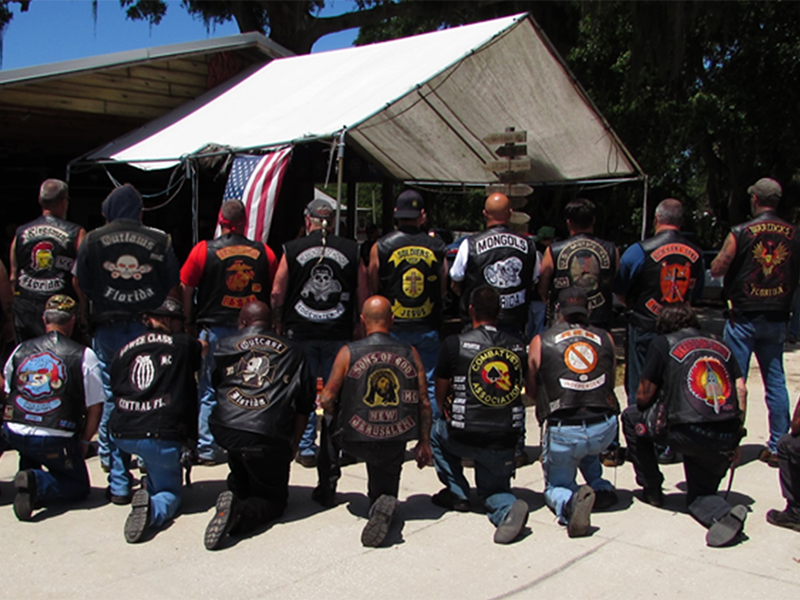
Most established clubs run on the same three things: a patch system, a rank hierarchy, and a set of bylaws members follow or face consequences. The details vary more between clubs than any single account suggests. The first two get mixed up constantly, and they are separate systems — the patch on your back says who you belong to and where, while rank is carried on small officer tabs worn on the front of the cut.
The Three-Piece Patch
A club's three pieces encode identity and territory, not rank: the top rocker names the club, the center patch is its emblem, and the bottom rocker names the territory the chapter claims. That bottom piece is where the violence starts — a state name across your back is a claim, and rival clubs read it exactly that way. A single one-piece patch usually signals a riding club rather than an MC, though piece count alone is not a reliable test and clubs do not all follow the same convention.
Who wears which piece and when, what the square MC tab means, which marks are earned rather than bought — that is a subject of its own, and we keep it in one place: our guide to biker patches. The numbers and letters riding alongside them — 81, 13, AFFA — are decoded separately.
The Hierarchy
Most clubs run on a rank system. The same titles recur across many of them — what changes is how much power each position actually holds:
| Rank | What They Actually Do |
|---|---|
| President | Runs the chapter. Represents the club externally. Has final say in disputes — but can be voted out by membership. |
| Vice President | Takes over when the president is absent. Often handles logistics for runs and events. |
| Sergeant-at-Arms | Enforcer. Maintains order at meetings and events. Handles discipline — fines, suspensions, or worse. |
| Road Captain | Plans routes, leads group rides, sets formation. In a convoy of 30+ bikes, this person keeps everyone alive. |
| Secretary / Treasurer | Tracks dues, manages finances, records meeting minutes. Dues are set per chapter and are rarely published; treat any figure you find online as an estimate. |
| Patched Member | Full member. Wears the three-piece patch. Has voting rights in "church." Must attend mandatory events or face fines. |
| Prospect | Probationary period, with the length set by the chapter. No vote, limited church access. Does whatever patched members need — federal cases describe prospects being assigned menial and support work while they are evaluated. Patching in comes down to a vote of the existing members; the threshold is a club rule, not a universal one. |
| Hang-around | Not a member yet. Attends some events, gets observed by the club. This is the "interview" phase before becoming a prospect. |
The regular members' meeting — many clubs call it "church" — is mandatory where a club requires it. Miss it without a valid excuse and you'll get fined. Everything discussed in church stays in church. Members caught sharing club business with outsiders face punishment that ranges from fines to losing their patch entirely.
When Bikers and Civilians Went to War
Hollywood glamorized bikers in the 1960s. The reality in rural America was uglier. As clubs grew from 20-member groups into organizations with hundreds of riders, they started feeling untouchable. That fear did the work regardless of how accurate it was.

How and when that friction wound down is not something we could trace to an independent chronology, so we are not going to give you a tidy date for it. What is clear is that it stopped being worth the cost for both sides.
Today, confrontations like that are rare, and the real danger to riders is ordinary traffic. NHTSA counted 6,335 motorcyclists killed on U.S. roads in 2023 — 15% of all traffic deaths that year. Measured per mile travelled, the motorcyclist fatality rate ran almost 28 times the rate for people riding in passenger cars. If you're curious about how biker films shaped public perception, the movies from this era are where the stereotype was cemented.
Seven Outlaw Motorcycle Clubs You Should Know
The US Department of Justice classifies these seven clubs as "outlaw motorcycle gangs" (OMGs). That doesn't mean every member is a criminal — it means the organizations themselves have been linked to organized crime at the federal level.
Hells Angels MC
Founded 1948 in Fontana, California. The most widely recognized club internationally. An archived DOJ profile put it at 2,000 to 2,500 members in the US and 26 other countries; current totals are not reliably public. Affiliated entities sell branded merchandise, and the organization describes itself publicly as a motorcycle club. Federal investigations have linked chapters to drug manufacturing, weapons trafficking, and extortion. Hunter S. Thompson's Hell's Angels (1967) remains the best-known firsthand account of their early public years. For a deeper dive, read our full Hells Angels history.
Bandidos MC
Founded in Texas in the 1960s. The usual date, town and founder are repeated everywhere, but we could not tie them to a reliable archive. Estimates vary by source and none is authoritative. An older DOJ assessment put it at 2,000 to 2,500 members in the US and 13 other countries. The Bandidos have a heavy presence in Texas, and federal cases describe territorial conflict with rival clubs. Federal cases have connected them to methamphetamine production and cross-border cocaine trafficking. Their rivalry with the Cossacks MC led to the 2015 Waco shootout.
Mongols MC
A 2008 DOJ release places the club's formation in Montebello, California. The often-repeated story about Hispanic veterans turned away by the Hells Angels is not something we could source. Membership estimates vary widely between sources and eras. Federal authorities have described the club as extremely violent. Their rivalry with the Hells Angels has produced decades of violence. In 2008, the ATF's Operation Black Rain infiltrated the club and led to the first forfeiture case of its kind in the United States (more on that below).

Outlaws MC
Generally described as one of the oldest major American outlaw clubs; the founding is usually given as 1935 in McCook, Illinois. Their skull-and-pistons logo is recognizable worldwide. Former president Harry "Taco" Bowman was on the FBI's Most Wanted list before his arrest in 1999. He received two life sentences for murder conspiracy and racketeering.
Pagans MC
Founded 1959 in Prince George's County, Maryland. An older DOJ estimate put the club at 200 to 250 members along the US East Coast — New York, Pittsburgh, Philadelphia and the Mid-Atlantic. New Jersey investigators have since documented rapid expansion, so that figure should not be read as current. Unlike other major MCs, the Pagans don't have international chapters. They're deeply territorial and have been linked to drug distribution, extortion, and arson. In June 2021, federal prosecutors in New Jersey announced a cumulative total of eleven Pagans members charged with narcotics distribution, firearms offenses and violent crimes in aid of racketeering.
Sons of Silence MC
Founding usually given as 1966 in Niwot, Colorado. An archived DOJ profile estimated 250 to 275 members in 30 chapters across 12 states, plus five chapters in Germany — historical figures, not current ones. A 1999 federal operation against the club produced dozens of arrests and seizures of methamphetamine and firearms; the exact totals differ between accounts. They keep a lower public profile than the Hells Angels or Bandidos but remain a significant presence in Mountain West states.
Vagos MC
DOJ sources place the club's beginnings in California in the late 1960s. Official historical membership estimates run from roughly 300 to nearly 600; associate numbers are not reliably public. The Vagos operate across California, Nevada, Oregon, Hawaii, and into Mexico. Their green patch makes them instantly recognizable. Federal investigations have resulted in arrests for weapons possession and drug trafficking. One case worth stating carefully: after booby traps targeted Hemet police in 2010, Vagos members were publicly suspected and raided, but the two men later prosecuted for the devices had no connection to the club, and Riverside County settled the club's defamation suit in 2011.
Three Legal Cases That Reshaped MC Culture After 2015
Most people know the names and the crimes. What they don't know is how a handful of court cases fundamentally changed the relationship between motorcycle clubs and the US legal system.

The Waco Shootout — And Why Every Charge Was Dropped
May 17, 2015. Twin Peaks restaurant, Waco, Texas. A meeting between the Bandidos, the Cossacks, and the Scimitars MCs turned into a gunfight that left 9 dead and 20 wounded. Police arrested 177 people at and around the scene — an extraordinary mass arrest — and set bail at $1 million per person.
What most articles leave out is that the prosecution fell apart. Only one case went to trial — Bandido Jake Carrizal — and it ended in a mistrial after jurors deadlocked. By April 2019, every remaining case was dismissed. The reasons? Evidence handling problems, overcharging, and allegations that police were already positioned with snipers before the fight started. An Associated Press review of the ballistics evidence found that four of the nine dead were struck by .223-caliber rifle rounds — the only weapon type police fired that day. A grand jury later declined to indict the officers involved.
The Waco case became a textbook example of prosecutorial overreach. For motorcycle clubs, it proved something they'd always argued: that law enforcement treats bikers as guilty by association. For defense attorneys, it became a cautionary tale about mass arrests based on patch affiliation rather than individual evidence.
The Mongols Trademark Case — Can the Government Seize a Club's Identity?
This is the case every motorcycle club in America watched closely. After the ATF's Operation Black Rain ended in October 2008 with 61 Mongols arrested on an 86-count federal racketeering indictment, the DOJ didn't stop there. They asked the court to seize the Mongols' federally registered trademark — their logo, their name, the thing on the back of every member's cut.
The argument: the Mongols' logo was an "instrument of crime" used to intimidate and facilitate illegal activity. On December 13, 2018 a jury convicted Mongol Nation on both RICO counts, and on January 11, 2019 the same jury returned a special verdict finding the club's collective membership marks forfeitable. Then it stalled. On February 28, 2019 Judge David O. Carter of the Central District of California let the conviction stand but refused to order the marks handed over, holding that forcing the transfer of a collective membership mark would violate the First Amendment (free expression) and the Eighth Amendment (excessive fines).
This was unprecedented. No government had ever tried to strip an organization of its name and emblem through criminal forfeiture. If it had succeeded, the legal framework could have been applied to any organization — not just motorcycle clubs. Constitutional law professors followed this case more closely than most gang prosecutions ever get. The Ninth Circuit closed it out on January 6, 2023, affirming both the conviction and the refusal to hand over the marks — but it decided the forfeiture question on statutory grounds, holding that RICO provides no way to extinguish a trademark without title actually passing to the government. It expressly declined to rule on the First and Eighth Amendment questions. The Mongols kept the patch; the constitutional question is still open.
RICO in the 2020s — The Federal Playbook Evolves
Federal agencies haven't stopped pursuing outlaw MCs. A December 2020 New Jersey case charged eleven Pagans members with narcotics, firearms and violent-crime offenses. Federal prosecutions of Texas outlaw clubs continued through the 2020s. The ATF continues running long-term undercover operations — some lasting over three years before a single arrest is made.
But the legal landscape has shifted. Post-Waco, prosecutors are more selective about charges. Post-Mongols, they're more cautious about overreach. The clubs haven't gone away. They've adapted. And their lawyers have gotten better.
What MC Culture Looks Like in the 2020s
The biker world in 2026 doesn't look like the biker world of 1975. Some changes are demographic. Others are structural. A few would have been unthinkable a generation ago.

Public demographic data on club membership is thin. The men who built these clubs in the late 1940s are gone or close to a hundred years old, and the Vietnam-era generation that took over is now in its seventies and eighties. Recruitment slowed with them — the counterculture appeal that drew young men in the 1960s doesn't hit the same way when you can rebel with a YouTube channel instead of a Harley. Who is actually on the road now — median rider age, how many women ride, where the money goes — is a different question, and we take it apart in our look at the two poles of modern motorcycle culture.
Social media is a serious problem. Most 1% clubs now have strict social media policies. No photos of church meetings. No club business on Facebook or Instagram. No pictures of members' cuts without permission. Prosecutors use social media as evidence — a single Instagram post has been used to establish gang affiliation in federal court.
Charity work is more visible than ever. Annual toy runs, veteran fundraisers, and disaster relief efforts have become a major part of how motorcycle clubs — both 1% and 99% — interact with the public. Many riders joined clubs specifically for the community-service mission, not the outlaw image.
The support club economy is massive. Major outlaw clubs operate networks of "support clubs" that act as feeder organizations — they handle logistics, turn out for events, work as a recruitment pipeline, and the merchandise alone, shirts and hoodies and stickers, is a business in its own right. Biker culture's influence on fashion extends far beyond the clubs — skull symbolism in biker identity has crossed over into mainstream jewelry and streetwear — pieces like our tattoo skull ring and memento mori skull rosary come straight from that lineage.
Women are building their own clubs. The Motor Maids — founded in 1940 — is the oldest women's motorcycle organization in North America. Newer clubs like The Litas and Chrome Divas have chapters across the US. Most traditional 1% clubs still don't allow women as full patched members, but the broader MC world is far more inclusive than it was even 20 years ago.
Frequently Asked Questions
What's the difference between a motorcycle club and a riding club?
By convention a motorcycle club (MC) wears a three-piece patch, claims territory, and operates under bylaws with meetings and a rank structure, while a riding club (RC) wears a one-piece patch and functions more like a social group. These are conventions rather than definitions — the Vagos, described by federal prosecutors as an outlaw club, wore a two-piece patch. Confusing the two — especially wearing MC-style patches without authorization — can create serious problems in the riding community.
How long does it take to become a full member of a motorcycle club?
There is no fixed timetable — every chapter sets its own. Federal prosecutors describing the Vagos laid out the sequence rather than the clock: association, then hang-around, then prospect under a sponsor, then a vote of the patched members. How long each stage runs, and how many votes it takes, is a club rule rather than a standard. For more on the process, see our post on how joining a motorcycle club works.
Are there motorcycle clubs that aren't outlaw?
Yes — and they far outnumber the outlaw clubs. The Blue Knights are active and retired law enforcement officers. The Red Knights are firefighters. BACA (Bikers Against Child Abuse) sends riders to escort abused children to court. These clubs wear three-piece patches, follow MC protocols, and are respected in the broader riding community.
Why do bikers wear skull imagery?
Skull imagery connects to the military memento mori tradition — a reminder that death rides alongside you. The first American clubs date to 1903-1904, decades before the postwar veterans most people associate with the imagery, so the symbol arrived in club culture by a longer route than the usual telling suggests. That meaning has evolved, but the connection between skull rings and biker identity remains strong.
American biker clubs aren't going anywhere. The names change, the members age, and the legal battles evolve — but the core structure has survived since 1948. Whether you're researching MC culture, considering a ride, or choosing biker jewelry that means something, understanding how these clubs work gives you context that goes beyond the surface. Start with the history. Respect the code. And if the skull-and-crossbones resonates, our biker ring collection draws from the same tradition these clubs built.