

Most "types of rings" guides list the same 10 styles with dictionary definitions. This one covers 29 — including five you won't find in typical guides — with the history, cultural weight, and practical details that actually help you pick one.
Whether you're shopping for a ring that means something on a specific finger or just want to know what separates a cocktail ring from a statement ring, everything's here.
Key Takeaway
Ring types fall into four broad camps: relationship rings (promise, wedding, eternity), statement rings (cocktail, armor, dome), symbolic rings (signet, birthstone, knot), and design-defined rings (solitaire, band, filigree). Knowing the category helps you narrow down what you're actually looking for.
Rings That Signal a Relationship
Five ring types exist specifically to tell the world something about your relationship status. Each one carries a different weight — from "I'm interested" to "till death."

Promise Rings
The idea goes back to 16th-century England, where lovers exchanged "posy rings" — bands engraved with short poems in Norman French. The tradition stuck, though the poetry got replaced by simpler gestures. A promise ring today says "I'm committed" without the formal weight of an engagement. No timeline, no obligation to propose next. It just means the relationship is serious.
They're not just for couples, either. Parents give them to children. Friends exchange them. The Catholic Church once used a version called a "chastity ring" for purity pledges. The common thread is a promise — any promise.

Engagement Rings
The first recorded diamond engagement ring was given in 1477 — Archduke Maximilian of Austria to Mary of Burgundy. But diamonds didn't become the default until 1947, when De Beers ran the "A Diamond is Forever" campaign. Before that, rubies and sapphires were just as common.
The "two months' salary" rule? Also De Beers, from the 1980s. There's no tradition behind it — just advertising. What matters is the ring itself and what it represents. Toi et moi settings (two stones side by side) are trending hard in 2026 after celebrity engagement announcements made them visible again.

Wedding Rings
Ancient Romans believed a vein ran directly from the fourth finger of the left hand to the heart — the "vena amoris." The anatomy is wrong, but the tradition survived. In Germany, Russia, and India, the wedding ring goes on the right hand instead. In Sweden, both partners wear engagement rings, not just the bride.
Materials vary by culture too. Platinum and gold dominate in the West. Stainless steel and tungsten are growing — cheaper, more durable, and better suited for people who work with their hands. The ring itself doesn't need to be expensive to mean something.

Eternity Rings
A continuous loop of identical stones around the entire band — no beginning, no end. Ancient Egyptians had a version around 2000 BCE, shaped like a snake swallowing its own tail (the ouroboros). The modern diamond eternity ring didn't become popular until the 1960s, when De Beers promoted it as an anniversary gift.
One practical note: full eternity rings (stones all the way around) can't be resized. If your finger size changes, the ring won't fit. Half-eternity rings — stones only on the top half — are easier to resize and more comfortable to wear daily.

Claddagh Rings
Two hands holding a heart, topped with a crown. The design comes from the fishing village of Claddagh in Galway, Ireland, around the 1700s. Richard Joyce — enslaved in Algeria for years — learned goldsmithing in captivity and forged the first one as a symbol of the love he carried.
How you wear it tells a story. Right hand, heart facing out: single and looking. Right hand, heart facing in: in a relationship. Left hand, heart facing in: married. It's one of the few rings with a built-in social signal that people still follow.
Rings That Demand Attention
These are rings you notice from across a room. Bold by design, not by accident.

Cocktail Rings
The name comes from American Prohibition (1920-1933). Women wore oversized, flashy rings to illegal cocktail parties as a quiet act of rebellion — the ring was a signal that you were drinking, which was technically a crime. The bigger the stone, the bolder the statement.
Cocktail rings are defined by drama. Large gemstones, ornate metalwork, designs that take up most of the finger. They're occasion rings — not something you'd wear while typing or doing dishes. If someone calls it a "dinner ring," that's the same thing.
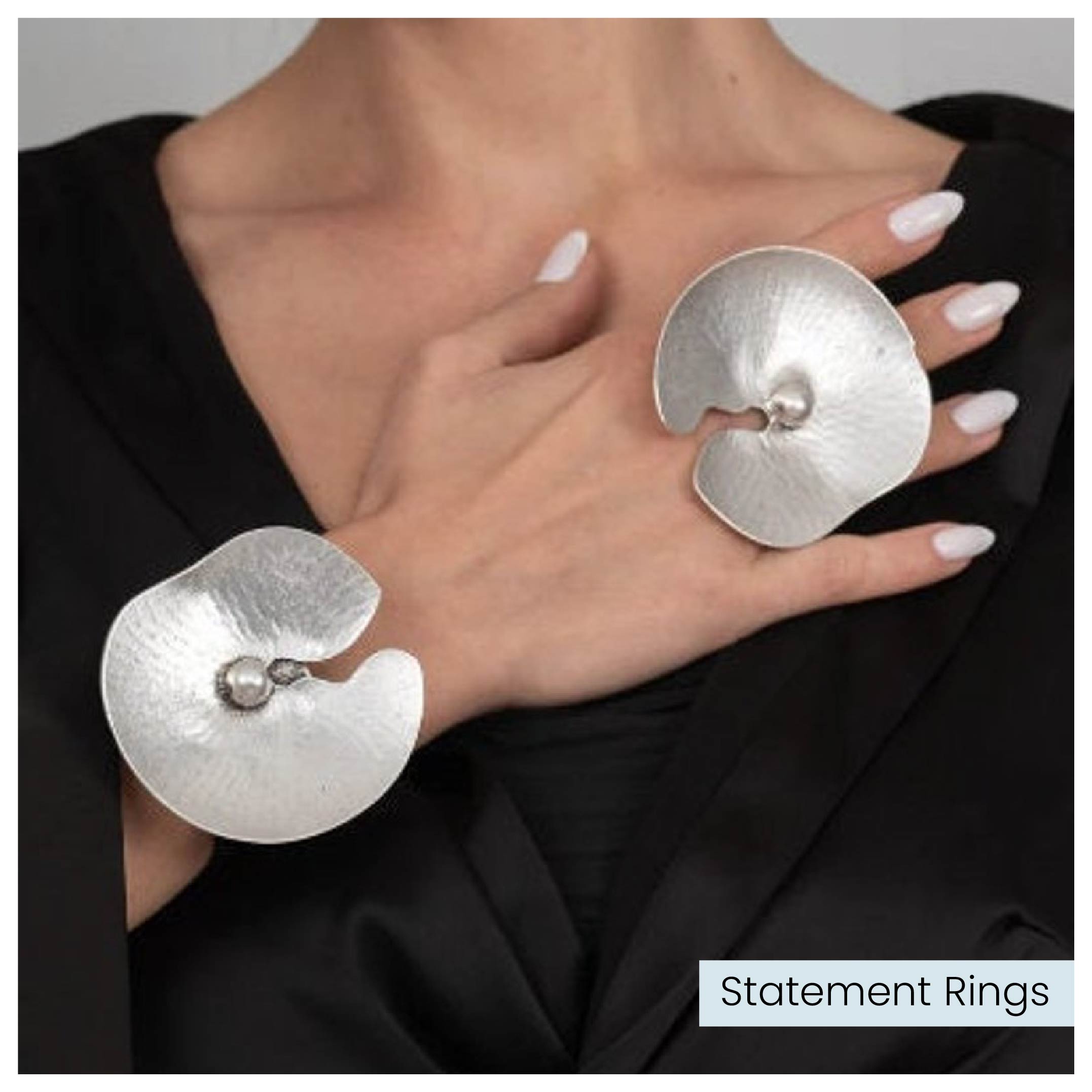
Statement Rings
Any ring that turns heads qualifies. Skull rings, oversized gemstones, architectural designs, animal motifs — statement rings are defined by impact, not style. The only rule: it should be the dominant piece on your hand.
The difference between cocktail and statement? Cocktail rings lean toward glamour and gemstones. Statement rings can be dark, aggressive, or abstract. A sterling silver dragon ring is a statement ring. A massive ruby on a gold band is a cocktail ring. Both are meant to be noticed — but the energy is different.

Armor Rings
Hinged or articulated rings that cover the full length of a finger — sometimes spanning two or three. The design has real historical roots: Ottoman Turkish archers wore thumb rings made of bone or metal to protect against bowstring snap. Medieval European versions were literal finger armor, part of full gauntlet sets.
Modern armor rings are built from stainless steel, sterling silver, or brass. The hinged joints flex with your finger — they're wearable, not stiff. In biker and gothic subcultures, armor rings are some of the most sought-after designs.

Dome Rings
A convex, rounded profile that catches light from every angle. Dome rings were a staple of the Art Deco era (1920s-1930s) and cycle back into fashion every decade or so. The curved surface creates a mirror-like reflection that flat rings can't match.
Despite their large appearance, most dome rings sit comfortably. The interior is usually flat or comfort-fit, so the height is all visual. Gold, silver, acrylic, wood — the dome shape works with nearly any material.

Nugget Rings
Born from the 1849 California Gold Rush, when miners turned raw gold nuggets directly into wearable rings instead of selling the metal. The irregular, textured surface became the design itself. By the 1980s, nugget rings had crossed into hip-hop culture — rappers, athletes, and entertainers wore them as symbols of self-made wealth.
Almost always yellow gold. The whole point is showing off the metal. A nugget ring in silver or steel looks wrong — the aesthetic only works because gold has that raw, unrefined appeal.
Rings That Carry Meaning
Some rings aren't about relationships or fashion. They represent identity, heritage, or personal belief.

Signet Rings
Before signatures existed, your ring WAS your identity. The word "signet" comes from the Latin signum — a sign or mark. Owners pressed the engraved face into hot wax to seal letters and legal documents. Forging someone's signet in medieval England was a capital offense. That's how much legal weight these rings carried.
Today, signet rings are worn for heritage, personal style, or family connection. Some still carry family crests. Others are blank-faced or engraved with initials. Traditionally worn on the pinky finger of the non-dominant hand.

Birthstone Rings
The modern birthstone list was standardized in 1912 by the American National Association of Jewelers. Before that, different cultures assigned different stones to each month — there was no universal list. January's garnet, April's diamond, July's ruby — all marketing decisions that stuck.
What makes birthstone rings interesting is the personal weight. The stone isn't decorative — it's tied to your birth month, your identity, or someone you love. That's why they're one of the most popular gift rings across cultures.

Knot Rings
Celtic knots have no beginning and no end — that's the entire point. They represent continuity, eternity, and interconnectedness. But similar endless-knot patterns show up independently in Norse, Islamic, and Chinese art, which suggests the idea resonates across cultures regardless of who came up with it first.
Common gift for anniversaries, bridal parties, and close friendships. The phrase "tying the knot" for getting married probably comes from this very tradition — though historians still argue over the exact origin.

Charm Rings
The concept of wearing charms for protection goes back to ancient Egypt. Small amulets — scarabs, ankhs, eyes of Horus — were attached to rings and worn as talismans against evil. Greek and Roman soldiers wore charm rings before battle. The belief was that specific symbols carried protective power.
Modern charm rings come in two forms: fixed motifs (hearts, stars, celestial symbols molded into the band) and dangling charms (small pendants that hang from the shank, similar to charm bracelets). Both styles let you carry personal symbolism on your finger.
Rings Defined by Their Construction
These ring types are named for how they're built, not what they symbolize.

Solitaire Rings
One stone, center stage. Tiffany & Co. changed solitaire design forever in 1886 when they introduced the six-prong setting that lifts the diamond above the band. Before that, stones sat flush against the metal. The raised mount lets light enter from below, which dramatically increases brilliance.
Solitaire doesn't mean diamond. Sapphires, rubies, emeralds, and even lab-grown moissanite work in the format. The defining feature is a single stone — no accents, no halos, nothing competing for attention.

Band Rings
The oldest ring form in existence. Earliest known examples date to the Neolithic period — over 5,000 years ago. A band is just a continuous loop of material with no stone, no engraving, no embellishment. Flat, concave, convex, hammered, brushed, polished — the variations are all in the finish and profile.
Still the most popular ring style globally. Wedding bands are the most common example, but plenty of people wear bands with zero romantic intent. A wide silver band on the index finger is one of the cleanest looks in men's ring styling.

Cluster Rings
Multiple smaller stones grouped tightly together to create the visual impact of a single large stone. Cluster rings gained popularity in the Georgian era (1714-1837) as a cost-effective alternative to large solitaires. The same carat weight spread across several stones costs significantly less than one stone of that size.
Common arrangements: flower shapes, starburst patterns, and asymmetric scatters. Mixed-stone clusters — diamonds paired with colored gems — are a Victorian specialty that's coming back in modern designs.

Filigree Rings
One of the oldest metalworking techniques still in use — over 5,000 years, originating in Mesopotamia. The name comes from Latin: filum (thread) + granum (grain). Metal is drawn into threads as thin as human hair, then twisted, curled, and soldered into ornamental patterns.
Each piece takes hours of handwork. You can't rush filigree, and you can't fake it with machine stamping — the wire patterns are three-dimensional and cast shadows. That's how you tell real filigree from imitations: hold it to the light.

Interlocking Rings
Multiple bands linked together so they move freely but can't be separated. The most famous version is the Russian wedding ring — three interlocking bands in rose, white, and yellow gold, each representing faith, hope, and love. Also called a "rolling ring" because the bands tumble over each other on your finger.
In Chinese culture, interlocking rings symbolize the interconnectedness of all things. Celtic versions use the same concept but with knotwork woven through the connection points. The meaning shifts by culture, but the structural idea — things linked inseparably — is universal.

Disconnected (Open) Rings
A deliberate gap in the band. The opening can be at the front (decorative) or at the back (adjustable). The visual tension of an incomplete circle is the whole point — it draws the eye exactly because something is "missing."
Open-front designs trace back to ancient Celtic knotwork, where negative space was as important as the material itself. Modern versions use the gap for gemstone placement — two stones facing each other across the opening, creating a "toi et moi" effect without a traditional setting.
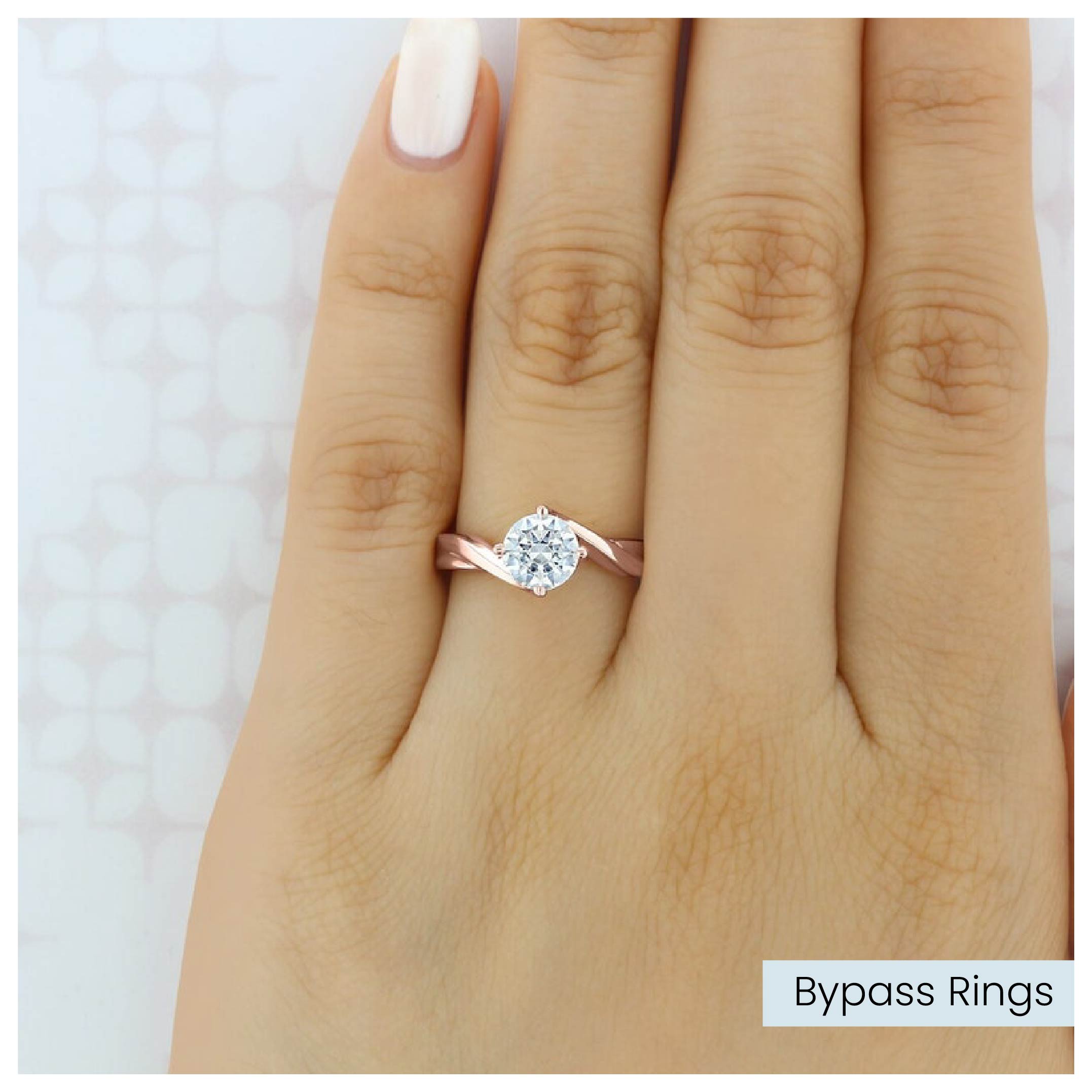
Bypass Rings
The band wraps around the finger and the two ends pass each other without meeting. Snake rings — where a serpent's head meets its own tail — are the most iconic bypass design and date back to ancient Greece. Cleopatra reportedly wore gold snake rings as symbols of eternal rule.
Leaf, vine, and floral bypass rings are popular in modern fashion. The asymmetric design looks more dynamic than a closed band — and gemstones placed at either end create two focal points instead of one.

Adjustable Rings
An open-back band that bends to fit different finger sizes. Best for: gifts when you don't know the recipient's size, travelers who swell in hot climates, or anyone who likes wearing the same ring on different fingers.
The trade-off is structural. A closed band distributes pressure evenly. An adjustable band has a weak point at the opening and can warp over time with heavy metals. Best materials for adjustable rings: sterling silver, brass, and stainless steel — they hold their shape better than softer gold.
Rings Defined by Their Stone

Diamond Rings
Graded by the 4Cs: cut, clarity, color, and carat weight. Of these, cut matters most for visual impact — a well-cut 0.8 carat diamond outshines a poorly cut 1.2 carat. Color grades run D (completely colorless, rarest) through Z (visible yellow/brown tint).
Lab-grown diamonds are chemically, physically, and optically identical to mined diamonds — same carbon crystal structure, same hardness (10 on Mohs scale), same refractive index. The only difference is origin. They cost 30-50% less and have been growing in market share since 2020. By 2025, lab-grown accounted for roughly 20% of engagement ring sales in the US.
Pearl Rings
Natural pearls form when an irritant enters a mollusk and the animal coats it in nacre (mother of pearl) layer by layer. Finding one is rare — roughly 1 in 10,000 wild oysters produces a gem-quality pearl. That's why 95%+ of pearls sold today are cultured: a human inserts a nucleus bead, and the mollusk does the rest.
Four main types: Akoya (classic white luster, saltwater), Tahitian (dark, naturally colored, saltwater), South Sea (large, warm tones, saltwater), and Freshwater (varied shapes, most affordable). Pearl rings need more care than stone rings — pearls are soft (2.5-4.5 Mohs), sensitive to chemicals, and can dry out if stored without moisture.
Five Ring Types Most Guides Don't Cover
These rarely show up in standard ring guides, but they have fascinating histories and real demand.
Poison Rings (Locket Rings)
A ring with a hidden compartment under a hinged bezel. The "poison" name is dramatic but not inaccurate — Cesare Borgia allegedly used one to slip cantarella into his enemies' wine glasses during dinner in 15th-century Rome. Whether those stories are history or legend is still debated.
The real uses were less sinister. Medieval Europeans stored holy relics inside them. Elizabeth I kept a miniature portrait of her mother Anne Boleyn in a locket ring — discovered only after the queen's death in 1603. Victorian versions held locks of a loved one's hair, perfume-soaked cloth, or tiny photographs. Today, collectors pay $5,000-$7,000+ for authenticated antique locket rings.
Puzzle Rings
Two to twelve interlocking bands that form a single ring when assembled correctly — and collapse into a tangled knot when removed. Also called Turkish wedding rings. The legend: a jealous sultan gave his wife a puzzle ring so he'd know if she ever took it off, because she wouldn't be able to reassemble it.
Whether the legend is real or not, the mechanical design is genuinely impressive. A four-band puzzle ring is solvable in minutes once you learn the trick. A twelve-band ring can take hours. YouTube tutorials for puzzle ring solutions have millions of views — the "how does it work?" factor drives constant interest.
Spinner Rings (Meditation Rings)
An inner band that rotates freely around the outer band. The concept traces back to Tibetan prayer wheels (mani wheels) — spinning the wheel was equivalent to reciting a mantra. Spinner rings borrow that idea: rotate the band as a form of meditative focus.
They've seen a surge in 2024-2026 as "anxiety rings" or "fidget rings" in wellness and mental health communities. The spinning motion gives your hands something to do during stress without being obvious. No clinical studies prove they reduce anxiety, but the tactile feedback is real and users swear by it.
Mourning Rings
Rings made specifically to memorialize the dead. The practice peaked in Victorian England after Prince Albert died in 1861 — Queen Victoria wore his mourning ring every day for the remaining 40 years of her life, and the entire country followed her lead into elaborate mourning rituals.
The rings often contained woven hair of the deceased, set under glass or crystal. Some were engraved with the person's name and death date. Shakespeare, Samuel Johnson, and George Washington all specified in their wills that mourning rings be distributed to friends after their deaths. It was considered an honor to receive one.
Smart Rings
Rings with embedded electronics. The Oura Ring tracks heart rate, sleep, body temperature, and blood oxygen — over 5.5 million units sold since launch. Samsung's Galaxy Ring entered the market in 2024. The smart ring market was valued at $518 million in 2025 and is projected to reach $3.7 billion by 2034.
NFC payment rings are a separate category — brands like McLear and Token let you tap your ring instead of a card or phone. No battery, no charging. The chip is passive and powered by the payment terminal's radio field. It's a small market now, but the concept of replacing your wallet with a ring is hard to ignore.
Pro tip: If you're trying to identify a ring type, look at three things: Does it have stones? (How many, what kind.) What shape is the band? (Closed, open, bypass, interlocking.) What's the intent? (Relationship, fashion, symbolism, function.) Those three questions narrow down the type every time.
Frequently Asked Questions About Ring Types
What is the difference between a promise ring and an engagement ring?
A promise ring signals commitment without a marriage proposal. The timeline stays open. An engagement ring is a direct proposal with a wedding date in mind. Promise rings tend to be simpler in design, while engagement rings usually feature a prominent center stone.
Which types of rings work best for everyday wear?
Band rings, signet rings, and dome rings. They sit low on the finger and don't snag on things. Stainless steel and sterling silver handle daily wear better than softer metals like brass or gold. Cocktail and cluster rings are better saved for events.
What are the most popular ring types for men?
Signet rings, band rings, and statement rings. Signet rings carry heritage. Band rings keep things minimal. Statement rings — skull designs, armor rings, gemstone pieces — express personality. Men's engagement rings are also growing, with sales up over 200% since 2022.
Can you stack different types of rings on one hand?
Yes. One bold ring per hand (statement or cocktail), then fill in with thinner bands or knot rings. Mixing metals works if it's intentional. Space rings across fingers rather than stacking three on one. Our ring stacking guide has specific combinations.
How do I choose the right ring type for my personal style?
Start with function. If you work with your hands, stick to bands or signet rings. If you dress up often, cocktail or cluster rings add the right attention. For personal meaning, go with a birthstone, Claddagh, or knot ring. For bold presence, browse our full ring collection.
Twenty-seven types, and each one exists because someone needed a ring that did something different. The best way to find yours is to figure out what the ring needs to do for you — signal something, express something, or just look right on your hand.