

Key Takeaway
Christian rings date back to the Roman catacombs — simple iron bands with Chi Rho engravings that identified believers to each other. Today they carry the same core symbolism (crosses, fish, doves, angels) across designs ranging from prayer bands to bold statement rings. The metal, the symbol, and the intent behind it all matter when choosing one.
Christian rings are among the oldest forms of religious jewelry still in daily use. The earliest examples — thin iron and bronze bands with carved Chi Rho symbols — date to the 3rd and 4th centuries, when open displays of faith could get you killed. Wearing a cross wasn't an option. A small engraved ring was discreet enough to identify you to fellow believers without attracting Roman authorities.
That survival function evolved over 1,700 years into something broader. Catholic rings with prayer inscriptions became portable amulets. Bishop rings marked ecclesiastical rank. Signet rings sealed papal documents. And in the 21st century, Christian rings serve every purpose from daily devotion to fashion statement — sometimes both at once. This guide covers the history, the symbols you'll find on them, the different cross types used in ring design, and practical advice on choosing one that fits your purpose. If you're looking at options now, our Christian ring collection shows the full range.
From Roman Catacombs to Church Shops
The Vatican Museum holds one of the largest collections of early Christian artifacts. Among the icons, censers, and medallions from the 3rd and 4th centuries are the earliest known Christian rings. These weren't decorative — they were functional. In an era when Christianity was illegal under Roman law, believers needed discreet identifiers. A ring engraved with the letters XP (Chi Rho, the first two letters of Christos in Greek) served as a silent handshake between those who shared the faith.

The Bible itself mentions rings in several contexts — always as symbols of authority and covenant. Pharaoh gave Joseph his ring as a transfer of power. Artaxerxes gave his ring to Haman to seal a royal decree. The prodigal son received a ring from his father as a symbol of restored dignity. These weren't fashion accessories. They were declarations.
In Europe, the tradition of wearing Christian rings arrived with Christianity itself from Byzantium during the first millennium. By the Middle Ages, prayer inscriptions had been added — turning the ring from an identifier into a portable devotional object. The words "Bless and Save" or passages from the Psalms were carved into the inner band, invisible to others but felt against the skin. That tradition persists today in rings that carry scripture passages alongside their cross designs.
Amulet, Symbol, or Fashion Statement?
Not everyone who buys a Christian ring considers it a sacred object. Some wear them as daily reminders of faith. Others treat consecrated rings as genuine amulets with protective properties — and there's a long church tradition supporting that view. Prayer rings blessed with holy water were widespread by the 19th century, and many believers still insist that a consecrated ring carries spiritual weight that an ordinary one doesn't.
Then there's a third category: people who simply find the aesthetic compelling. A sterling silver cut-out cross ring works as a style piece regardless of the wearer's beliefs. Even among clergy, there's no consensus on where "symbol of faith" ends and "protective amulet" begins. The honest answer is that the ring means whatever it means to the person wearing it. Church officials generally agree on one thing: the primary purpose is to remind the wearer of their relationship with God — everything else is secondary.
Bishop and Papal Rings
The most famous Christian rings belong to the church hierarchy. Bishop rings — large amethyst-set gold bands — are presented during consecration as a symbol of the bishop's spiritual marriage to his diocese. The Pope wears the Ring of the Fisherman, a gold signet depicting St. Peter casting a net, destroyed ceremonially with a silver hammer when each pope dies.

Both designs have migrated into secular fashion — bishop rings through biker culture, papal-inspired signets through men's jewelry trends. If you want the full story on styles, gemstones, and how to wear one outside the church, we wrote a complete bishop ring guide that covers all of it.
Symbols Found on Christian Rings
Christian jewelry traditionally favors restraint — apostolic teachings caution against ostentation. That's why the symbolism on Christian rings carries the weight, not the material. Most of these symbols predate Christianity itself and were reinterpreted through a biblical lens. Here's what you'll encounter and what each one means.
The Cross. The most universal Christian symbol, though it was dreaded as a method of execution before Christ transformed its meaning. On rings, crosses range from simple Latin forms to elaborate Calvary and Celtic designs. A crucifix ring (showing Christ's body on the cross) carries a different weight than a plain cross ring (representing the resurrection rather than the suffering). The distinction matters to many wearers.
Ichthys (Fish). One of the oldest Christ symbols. The Greek word for fish, IXThYS, forms an acrostic: Jesus Christ, Son of God, Savior. Early Christians used the fish as a covert identifier — one person would draw a single arc in the sand, and if the other completed the fish shape, they knew they shared the faith. The symbol appears on rings as an engraved outline, a raised relief, or sometimes as a full fish-shaped band section.

Dove. Represents the Holy Spirit — the third person of the Trinity. The imagery comes directly from the Gospels, where the Holy Spirit descends "like a dove" at Christ's baptism. A dove with an olive branch adds a second layer: the herald of peace, drawn from Noah's flood narrative. On rings, doves usually appear as engraved or embossed details rather than dominant design elements.

Angels and Archangels. Angels serve as intermediaries between heaven and earth. On Christian rings, specific archangels carry specific meanings: Michael (warrior with sword — justice and protection), Gabriel (carrying a lily — mercy and annunciation), Raphael (pilgrim with staff — healing), and Uriel (holding a scroll — wisdom and prophecy). Rings for men frequently feature Michael, while Gabriel appears more often in women's designs.
Eye of God. Depicted as an eye inside an equilateral triangle (the Trinity), the All-Seeing Eye represents divine omniscience. For Christians, it's a symbol of hope and watchfulness — God sees not only sin but also faithfulness. The image overlaps with Masonic and secular symbolism, which gives it an unusual dual life in jewelry design.

Other symbols you'll find: Grapes and vine (Eucharistic wine, Christ as "the true vine"). A ship or boat (the Church navigating the sea of life — the nave of a church takes its name from navis, Latin for ship). A star (the Star of Bethlehem guiding the Magi). A heart with flames (spiritual devotion, popular since the 15th century). The trefoil/clover (the Trinity — also the emblem of St. Patrick). And the rosary (piety and service, the beads representing continuous prayer). For deeper context on how medieval ring engravings encoded hidden meanings, we have a separate guide on that subject.
Cross Types in Christian Ring Design
Not all crosses are the same. The form engraved or cast on a Christian ring carries its own theological history. This section covers crosses with specifically Christian origins — Chi Rho, Jerusalem, Tau, and the foundational Latin and Greek forms. For a broader look at cross designs in ring jewelry — including Iron Cross, Maltese, Celtic, and Gothic variations — see our cross ring meaning guide. Browse the full range in our cross ring collection.
Chi Rho (XP). One of the earliest cruciform symbols — technically a monogram, not a cross. It combines the first two Greek letters of "Christ." Emperor Constantine adopted it after a vision before the Battle of Milvian Bridge in 312 AD, ordering it painted on his soldiers' shields. After his victory, Chi Rho became the official emblem of the Roman Empire. Archaeological evidence confirms it appeared on Constantine's personal helmet and shield.

Latin Cross. The vertical beam with a shorter horizontal bar above center. It predates Christianity as a shape, but the crucifixion permanently claimed it. On Christian rings, the Latin cross is the default for both Protestant and Catholic designs — its theological weight needs no explanation.
Greek Cross. All four arms are equal length — older than the Latin cross and traditional in Byzantine Christianity. Also called the Cross of St. George. Rings featuring the Greek cross often have an Eastern Orthodox or Byzantine aesthetic.
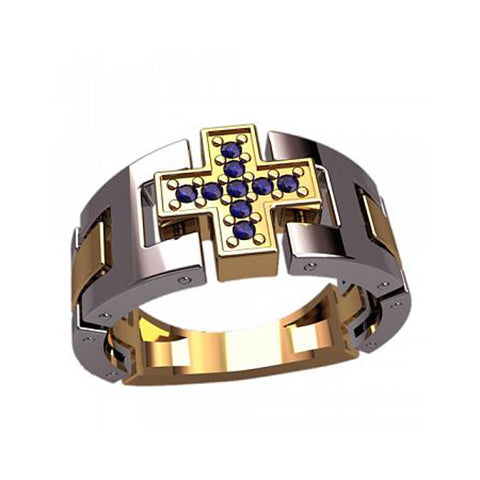
Tau Cross. Shaped like the Greek letter T. Known as the Cross of St. Anthony (founder of Christian monasticism, 4th century) and later adopted by Francis of Assisi in the 13th century. In heraldry, it's called the Almighty Cross. It symbolizes the transformation from Old Adam to New Adam through Christ's sacrifice.

Jerusalem Cross. Also called the Crusader Cross — one large Greek cross surrounded by four smaller ones. The five crosses represent the five wounds of Christ (hands, feet, and side). Alternative interpretations: four Gospels and four corners of the world (small crosses) united under Christ (large cross). This design appears frequently on faith rings and cross pendants as well.

Baptismal Cross. A Greek cross combined with the letter X — symbolizing rebirth through baptism. Less common on rings than the forms above, but it appears on faith bands designed for baptism gifts and confirmation keepsakes.
Choosing a Christian Ring: Metal, Style & Fit
Silver vs. gold. Silver is the traditional metal for Christian rings — symbolizing purity, innocence, and chastity in church tradition. It's also the practical choice: more affordable, more versatile, and available in a wider range of designs. Expect tarnish over time — that's normal oxidation, not a spiritual sign. A polishing cloth handles it in seconds. Gold historically represented divine glory and was reserved for clergy and the wealthy. Today there's no restriction — gold-plated sterling silver gives the visual warmth of gold at a fraction of the cost.
Design intent. A ring with an exterior cross or fish symbol is a visible declaration. A ring with a prayer inscription on the inside is personal and private — only you know it's there. Some wearers want both. Consider your context: a bold amethyst cross signet ring makes a statement at a church event. A slim band with an interior "Lord's Prayer" inscription works in any professional setting without drawing attention.
Fit and gender. Most Christian ring designs are unisex — the symbolism doesn't change based on who wears it. But proportions differ. Men's Christian rings tend to be wider (8-12mm bands) with bolder relief. Women's versions are typically narrower with more refined detailing, sometimes accented with enamel or small stones. Children's sizes exist but carry the same symbols. If you're buying as an ordination or faith milestone gift, matching the symbol to the recipient's tradition matters more than matching their style preference.
Frequently Asked Questions
Does a Christian ring need to be consecrated to have meaning?
That depends on your tradition. In Catholic and Orthodox practice, consecration by a priest with holy water and prayer is believed to give the ring protective spiritual properties. Protestant traditions generally don't require consecration — the ring's meaning comes from the wearer's faith, not a ritual. Either way, the symbolism on the ring is the same whether it comes from a church shop or an online store.
Which finger should a Christian ring go on?
There's no universal rule for laypeople. Clergy rings (bishop, papal) go on the right ring finger by tradition. For everyone else, wear it wherever it feels right. Many people choose the right hand to distinguish it from a wedding ring on the left. Some wear prayer rings on the thumb for easy access during devotional moments.
What's the difference between a crucifix ring and a cross ring?
A crucifix shows the body of Christ on the cross — emphasizing the sacrifice and suffering of the Passion. A plain cross (without the body) emphasizes the resurrection and triumph over death. Catholic tradition leans toward the crucifix; Protestant tradition generally prefers the empty cross. For a deeper dive into crucifix ring history — including WWII biker roots and the 3-nail tradition — see our crucifix ring symbolism guide.
Is the inverted cross a Satanic symbol?
Not originally. The inverted cross is the Cross of St. Peter — he asked to be crucified upside down because he didn't consider himself worthy of dying in the same manner as Christ. It remains an official symbol of the papacy. The Satanic association came from popular culture, not church history. In a Christian ring setting, it represents Peter's humility. For more on how the inverted cross and other designs shifted meaning across subcultures, see our gothic cross meaning guide.
Why is silver more traditional than gold for Christian rings?
Early Christian teachings emphasized modesty — "gold, pearls, and precious stones" were associated with vanity and pride. Silver symbolized purity without ostentation. Gold was reserved for clergy, who wore it as a representation of divine glory rather than personal wealth. Today there's no doctrinal restriction on gold for laypeople, but silver remains the default in most Catholic ring traditions.
Christian rings have carried the same core symbols for nearly two millennia — and the fact that those symbols still resonate says something about their staying power. Whether you're buying one as a daily reminder of faith, a gift for a baptism or confirmation, or simply because a well-made cross ring looks good on your hand, the history behind it adds a layer that purely decorative jewelry can't match. Browse the full Christian ring collection to find the design that fits your purpose.